Geography
Where coffee grows: a tour of the coffee belt
Almost all of the world's coffee grows in a band around the equator. Two countries grow more than half of it, and the type of bean they grow decides what ends up in your cup.
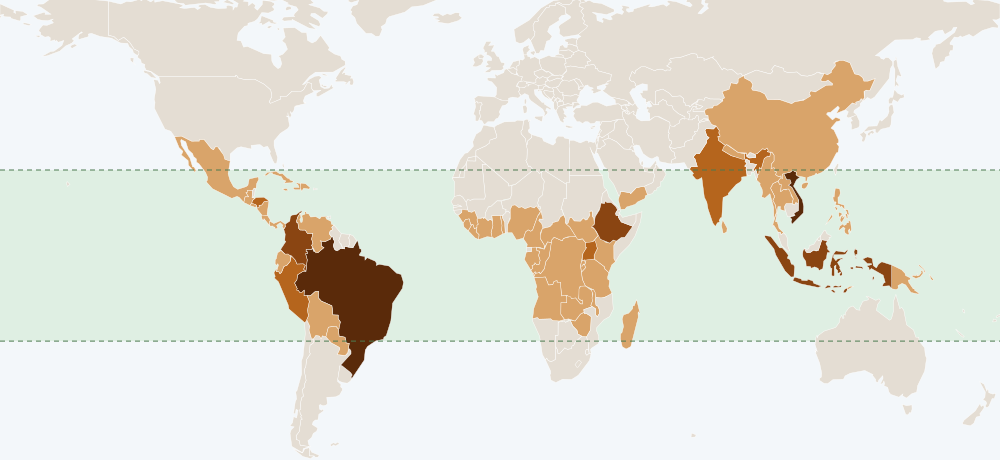
| Country | Million 60 kg bags | Share of world |
|---|---|---|
| Brazil | 71.9 | 38% |
| Vietnam | 32.5 | 17% |
| Colombia | 13.4 | 7% |
| Ethiopia | 12.1 | 6% |
| Indonesia | 11.4 | 6% |
| Uganda | 7.2 | 4% |
| India | 6.1 | 3% |
| Honduras | 6.0 | 3% |
| Peru | 4.8 | 3% |
Source: USDA FAS, Coffee: World Markets and Trade (July 2026)
Why coffee needs the tropics
The coffee plant is a tropical shrub. It does not survive frost, and it needs steady warmth and rain. That is why the producing countries sit roughly between the Tropic of Cancer and the Tropic of Capricorn, an area people call the coffee belt.
Arabica and robusta: two different coffees
Two species make almost all the coffee we drink:
- Arabica (Coffea arabica) is the original coffee from the Ethiopian highlands. It has more acidity and a fruitier taste, and it makes up the larger part of world production.
- Robusta (Coffea canephora) makes up about 45% of world production. The plant is less sensitive to pests and disease. Its coffee is more bitter, earthier and lower in acidity, and it has about 2.7% caffeine against about 1.5% for arabica. Most robusta goes into instant coffee, and good robusta is used in traditional Italian espresso blends for body and crema.
The USDA's July 2026 report shows how differently the big producers lean. Brazil's 71.9 million bag forecast splits into 47.5 million arabica and 24.4 million robusta. Vietnam's 32.5 million bags are almost all robusta (31.4 million). Colombia, Ethiopia, Honduras and Peru grow arabica only.
The big five
Brazil
Brazil has been the world's largest producer since the 1850s, and the 2026/27 forecast of 71.9 million bags is more than a third of the world total. About two thirds of it is arabica. Read how coffee got there in our history of coffee.
Vietnam
Vietnam is a clear number two with 32.5 million bags, nearly all robusta. It is the largest robusta producer in the world, so a large share of the world's instant coffee starts here.
Colombia
Colombia (13.4 million bags) grows only arabica, on the slopes of the Andes.
Ethiopia
Ethiopia (12.1 million bags, all arabica) is the homeland of arabica, where the plant still grows wild in the highlands. Ethiopian single-origin coffees are popular with specialty roasters.
Indonesia
Indonesia (11.4 million bags) grows mostly robusta (10.0 million bags). The Dutch started coffee plantations on Java in the late 17th century, and by 1719 "Java coffee" could supply Europe's demand.
Other names worth knowing
Uganda (7.2 million bags) is Africa's big robusta grower. India (6.1 million) grows both species in the south of the country and has its own brewing tradition, South Indian filter coffee. Honduras (6.0 million) and Peru (4.8 million) are major arabica producers. Many other countries, among them Kenya, Rwanda, Guatemala, Costa Rica, Mexico and Yemen, grow smaller amounts.
What this means when you buy beans
- "100% arabica" on the bag tells you the species, not the quality. Look for the country and, ideally, the region and roast date.
- Blends with robusta are not a bad sign for espresso. A little robusta gives a thicker crema and a stronger taste in milk drinks.
- Single-origin coffees show off one country or farm. Try an Ethiopian next to a Brazilian and you will taste the difference immediately.
Taste the map
Browse coffee beans for espresso and filter, or search for single-origin Ethiopian beans and Brazilian beans. A burr grinder lets you taste the difference best.
Sources
- USDA Foreign Agricultural Service: Coffee: World Markets and Trade, July 2026
- Wikipedia: History of coffee (spread of cultivation, Brazil since 1852)
- Wikipedia: Coffea canephora (robusta)
We checked these sources on the date shown above. If you spot a mistake, please tell us through the contact page.